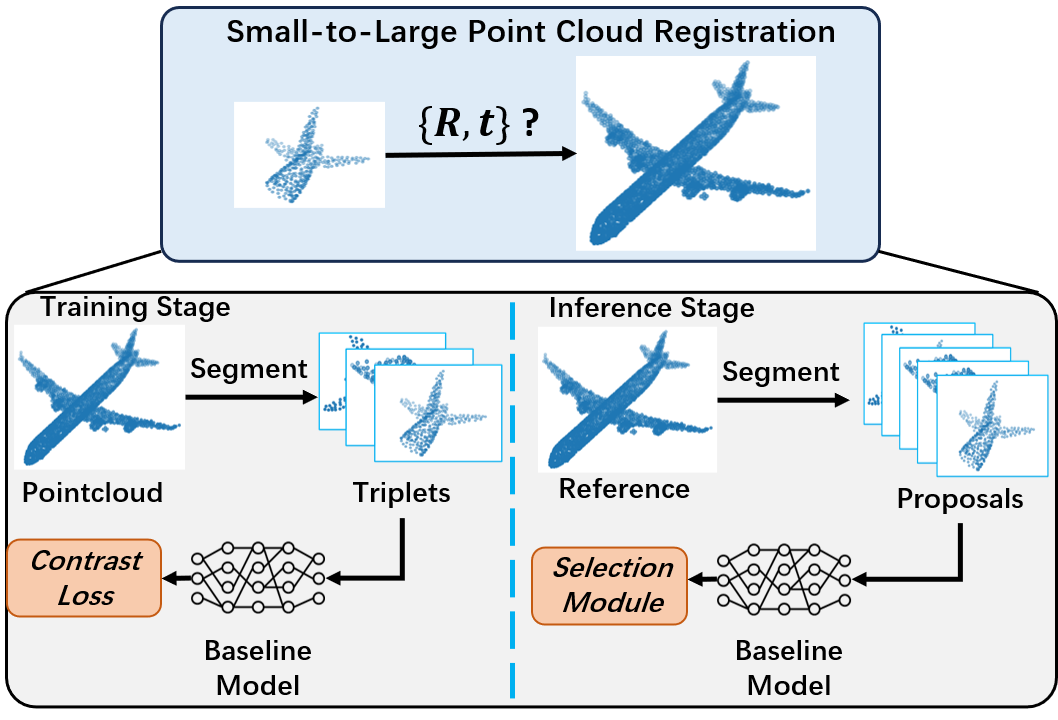
Point-cloud (PC) registration is fundamental to three-dimensional (3D) perception in robotic systems. However, classic registration algorithms falter when aligning a source PC containing limited, incomplete, or ambiguous geometric cues against a reference. This challenge of registering a small, partial PC to a significantly larger global reference is pervasive in real-world deployment yet remains insufficiently addressed by existing learning-based approaches, which typically assume comparable scales and significant overlap.
To bridge this gap, we propose the Region-based Small-to-Large Point-cloud Registration framework (R-SLPR), a novel three-stage architecture that fundamentally reformulates the scale-mismatched registration problem into a sequence of region proposal, regional matching, and iterative refinement. Unlike conventional methods that fail to localize specific regions, R-SLPR explicitly identifies candidate regions prior to estimating rigid transformations, ensuring robust alignment even under severe scale mismatch. The framework introduces a Fibonacci Grid Segmentation method coupled with a contrastive learning objective to effectively generate and match local geometric patches. Building on this, a novel Cascade Anchor Selection and Refinement algorithm iteratively aligns the source with the target region to maximize precision. Extensive evaluation on ModelNet40 demonstrates that R-SLPR establishes a new state-of-the-art accuracy standard, outperforming prior approaches and significantly reducing position and rotation Mean Absolute Error (MAE) to 0.009 and 1.104, respectively.
We formulate small-to-large point cloud registration as a region proposal, matching, and refinement problem. By localizing candidate regions before rigid transformation estimation, R-SLPR reduces the ambiguity caused by severe scale mismatch and limited overlap.
We introduce a patch-level contrastive learning strategy to distinguish corresponding regions from irrelevant ones. This improves the discriminability of local geometric features under incomplete and ambiguous observations.
We develop a Cascade Anchor Selection and Refinement module that iteratively evaluates and updates regional proposals. This allows R-SLPR to progressively converge toward the correct region and improve registration accuracy.
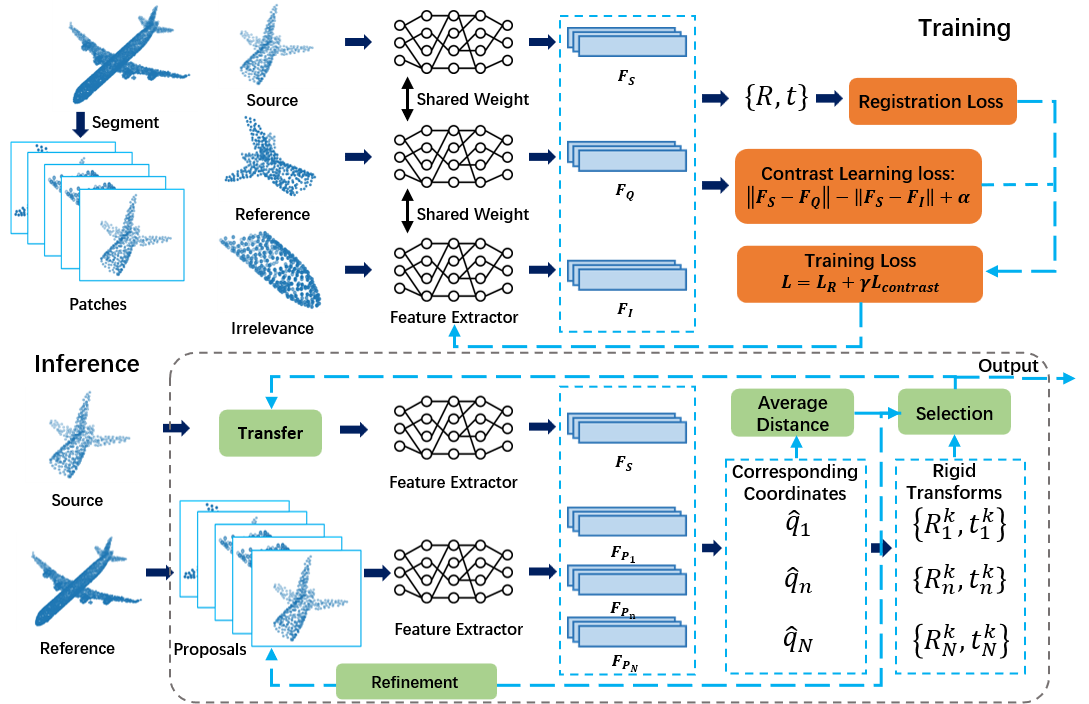
Overview of the proposed R-SLPR framework.
R-SLPR is designed for small-to-large point-cloud registration, where a small and incomplete source point cloud must be aligned with a much larger reference point cloud. Instead of directly matching the source to the entire reference, R-SLPR first identifies candidate local regions in the reference point cloud and then estimates the rigid transformation within the selected region.
The framework consists of three main steps: region proposal generation, proposal matching, and iterative refinement. First, the reference point cloud is segmented into multiple local proposals using Fibonacci Grid Segmentation. Then, a learning-based registration model evaluates the relationship between the source point cloud and each proposal, while contrastive learning improves the discriminability of regional features. Finally, Cascade Anchor Selection and Refinement updates the proposal anchors and gradually guides the search toward the correct matching region.
Fibonacci Grid Segmentation generates uniformly distributed anchor directions on the unit sphere and uses them to divide the large reference point cloud into regional proposals. Compared with direct global matching, this provides a more focused search space and allows the model to locate the region that is most likely to correspond to the small source point cloud.
The contrastive learning module trains the feature extractor with source, reference, and irrelevant point-cloud patches. It pulls corresponding source-reference regions closer in the feature space and pushes unrelated regions apart, making the learned features more suitable for distinguishing candidate regions under severe scale mismatch.
During inference, each regional proposal is evaluated by its predicted alignment quality. The best proposal is selected according to the average alignment distance, and its anchor direction is used to refine the proposal set in the next iteration. This cascade process progressively narrows the search area and improves registration robustness.
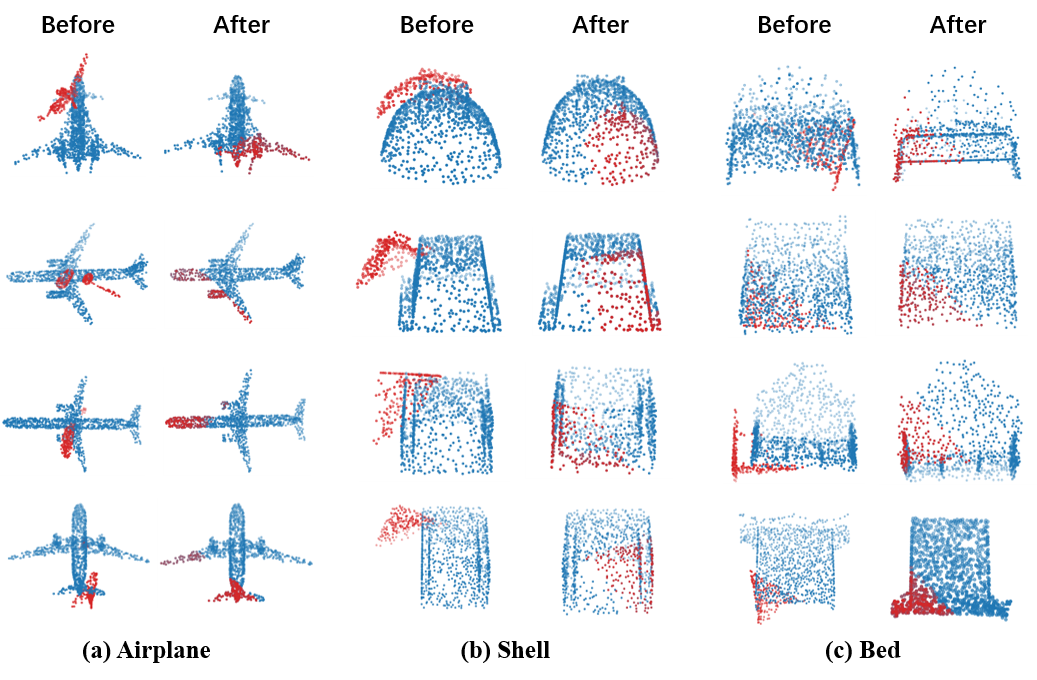
R-SLPR achieves state-of-the-art performance on the ModelNet40 benchmark for small-to-large point cloud registration. As shown in the comparison tables, R-SLPR consistently outperforms representative handcrafted and learning-based registration methods across clean, unseen-category, noisy, and noisy-unseen settings. Under the clean setting with a sampling rate of 0.2, R-SLPR achieves an RMSE-r of 2.632°, an MAE-r of 1.104°, an RMSE-t of 0.020, and an MAE-t of 0.009, obtaining the best overall performance among all compared methods.
Compared with previous methods, R-SLPR demonstrates clear advantages in both rotation and translation estimation. In particular, the improvement in translation accuracy is especially significant, as conventional registration methods often suffer from centroid inconsistency when directly aligning a small source point cloud with a much larger reference point cloud. By first identifying the corresponding local region in the reference point cloud and then estimating the rigid transformation, R-SLPR effectively reduces the impact of scale mismatch and enables more accurate small-to-large registration.
The robustness of R-SLPR is further verified under challenging noisy and unseen-category conditions. While several baseline methods show substantial degradation or fail to converge under noise, R-SLPR maintains stable registration accuracy across all evaluated settings. These results demonstrate that the proposed region-based formulation provides a reliable and generalizable solution for small-to-large point cloud registration.
| Method | Sampling Rate 0.2 | Sampling Rate 0.3 | ||||||
|---|---|---|---|---|---|---|---|---|
| RMSE-r (°) ↓ | MAE-r (°) ↓ | RMSE-t ↓ | MAE-t ↓ | RMSE-r (°) ↓ | MAE-r (°) ↓ | RMSE-t ↓ | MAE-t ↓ | |
| RPMNet | 4.102 | 2.223 | 0.065 | 0.020 | 3.841 | 2.011 | 0.039 | 0.026 |
| MFGNet | 29.158 | 18.802 | 0.450 | 0.304 | 13.272 | 10.366 | 0.180 | 0.135 |
| RORNet | 18.635 | 15.314 | 0.322 | 0.240 | 16.469 | 12.391 | 0.340 | 0.271 |
| MCLNet | 3.556 | 1.132 | 0.224 | 0.156 | 3.429 | 1.186 | 0.168 | 0.092 |
| R-SLPR (ours) | 2.632 | 1.104 | 0.020 | 0.009 | 3.304 | 1.268 | 0.027 | 0.012 |
| Method | Sampling Rate 0.2 | Sampling Rate 0.3 | ||||||
|---|---|---|---|---|---|---|---|---|
| RMSE-r (°) ↓ | MAE-r (°) ↓ | RMSE-t ↓ | MAE-t ↓ | RMSE-r (°) ↓ | MAE-r (°) ↓ | RMSE-t ↓ | MAE-t ↓ | |
| RPMNet | 4.368 | 2.371 | 0.071 | 0.042 | 4.129 | 2.413 | 0.056 | 0.035 |
| MFGNet | 30.556 | 20.222 | 0.237 | 0.173 | 11.521 | 7.072 | 0.090 | 0.060 |
| RORNet | 19.913 | 14.260 | 0.366 | 0.204 | 16.395 | 12.856 | 0.410 | 0.306 |
| MCLNet | 3.638 | 1.328 | 0.150 | 0.098 | 3.521 | 1.200 | 0.140 | 0.101 |
| R-SLPR (ours) | 2.833 | 1.234 | 0.026 | 0.012 | 2.977 | 1.183 | 0.023 | 0.010 |
| Method | Sampling Rate 0.2 | Sampling Rate 0.3 | ||||||
|---|---|---|---|---|---|---|---|---|
| RMSE-r (°) ↓ | MAE-r (°) ↓ | RMSE-t ↓ | MAE-t ↓ | RMSE-r (°) ↓ | MAE-r (°) ↓ | RMSE-t ↓ | MAE-t ↓ | |
| RPMNet | 4.562 | 2.740 | 0.072 | 0.025 | 3.985 | 2.219 | 0.047 | 0.019 |
| MFGNet | 33.340 | 21.842 | 0.404 | 0.320 | 14.395 | 9.567 | 0.168 | 0.124 |
| RORNet | 10.254 | 7.352 | 0.224 | 0.156 | 7.856 | 5.421 | 0.208 | 0.149 |
| MCLNet | - | - | - | - | - | - | - | - |
| R-SLPR (ours) | 2.613 | 1.142 | 0.027 | 0.013 | 2.974 | 1.229 | 0.021 | 0.010 |
| Method | Sampling Rate 0.2 | Sampling Rate 0.3 | ||||||
|---|---|---|---|---|---|---|---|---|
| RMSE-r (°) ↓ | MAE-r (°) ↓ | RMSE-t ↓ | MAE-t ↓ | RMSE-r (°) ↓ | MAE-r (°) ↓ | RMSE-t ↓ | MAE-t ↓ | |
| RPMNet | 4.714 | 2.828 | 0.041 | 0.022 | 4.114 | 2.263 | 0.033 | 0.019 |
| MFGNet | 80.267 | 61.713 | 0.424 | 0.348 | 14.952 | 10.697 | 0.127 | 0.084 |
| RORNet | 11.026 | 7.864 | 0.271 | 0.197 | 7.882 | 5.663 | 0.325 | 0.188 |
| MCLNet | - | - | - | - | - | - | - | - |
| R-SLPR (ours) | 2.851 | 1.101 | 0.031 | 0.014 | 2.673 | 1.174 | 0.028 | 0.011 |
The links to the datasets used in this paper are provided below.
@inproceedings{wan2026rslpr,
      title     = {R-SLPR: Region-based Small-to-Large Point-cloud Registration with Contrastive Learning},
      author    = {Wan, Yusen and Chen, Zeyuan and Zou, Qianshi and Chen, Xu},
      booktitle = {Underreview},
      year      = {2026},
    }