Delay-aware initial states
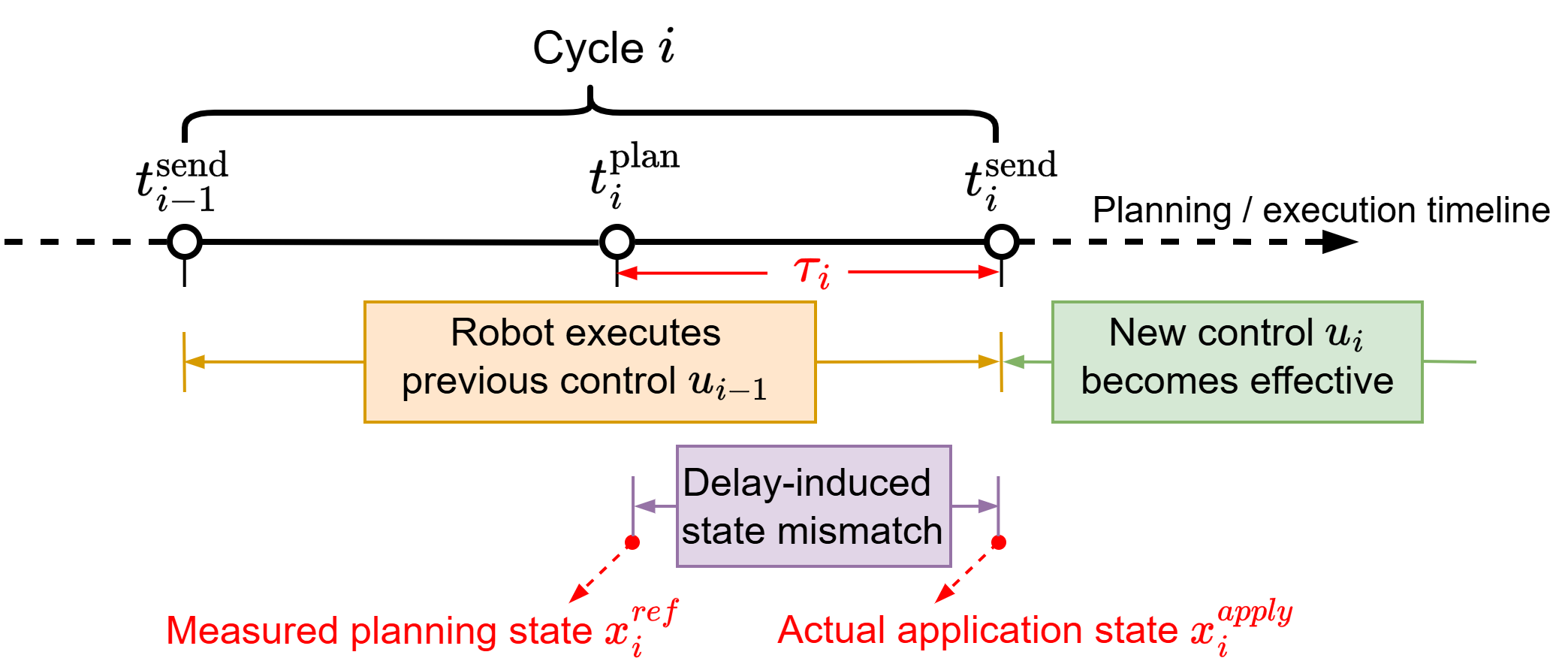
Represent execution-time state mismatch as a distribution of plausible initial states, and jointly sample initial-state and control perturbations for MPPI rollouts.
Department of Mechanical Engineering, University of Washington
Accepted to 65th IEEE Conference on Decision and Control (CDC 2026)



Bringing planning and execution closer together.
Delay-aware sampling. Rollout-based feedback. Closed-loop control.
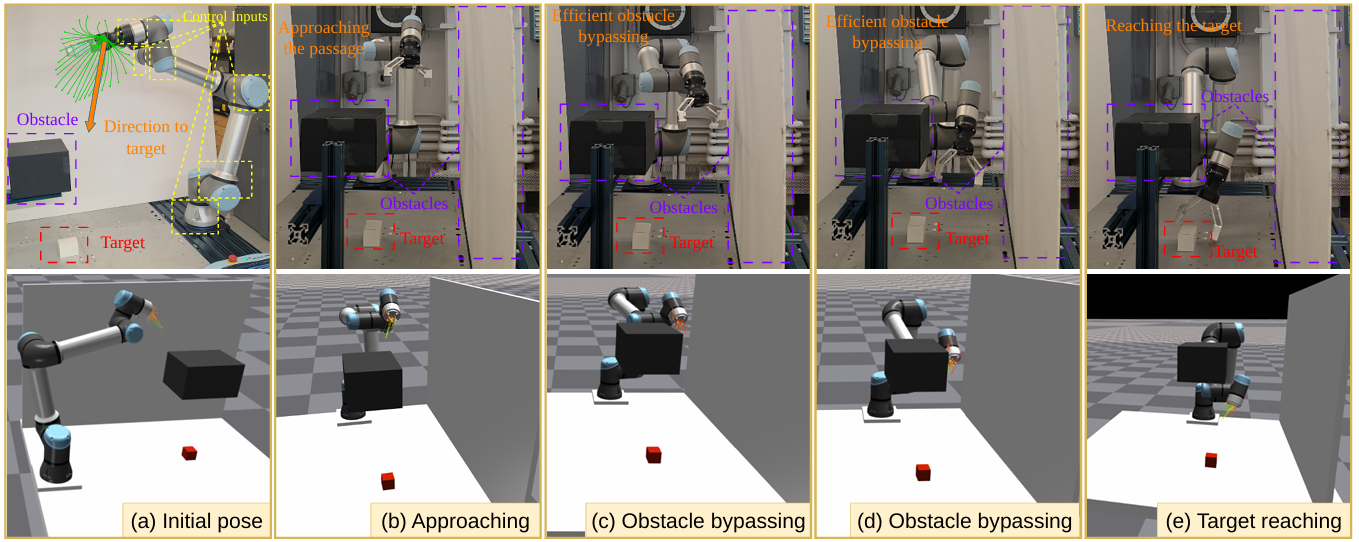
Hardware findings for the reported task; RMSE reductions are relative to standard MPPI.
What this work adds
Represent execution-time state mismatch as a distribution of plausible initial states, and jointly sample initial-state and control perturbations for MPPI rollouts.
Extract a nominal trajectory and local feedback gains from the weighted rollout distribution, then combine the MPPI feedforward update with online state-feedback correction.
Evaluate the combined formulation on a UR5e narrow-passage task, demonstrating improved collision avoidance and closer agreement between predicted and executed motion.
The challenge
By the time a new command takes effect, the state used to plan it can already be out of date. In a narrow passage, even a small deviation matters.
The approach
Account for uncertainty at the start of planning. Correct the remaining mismatch at execution.
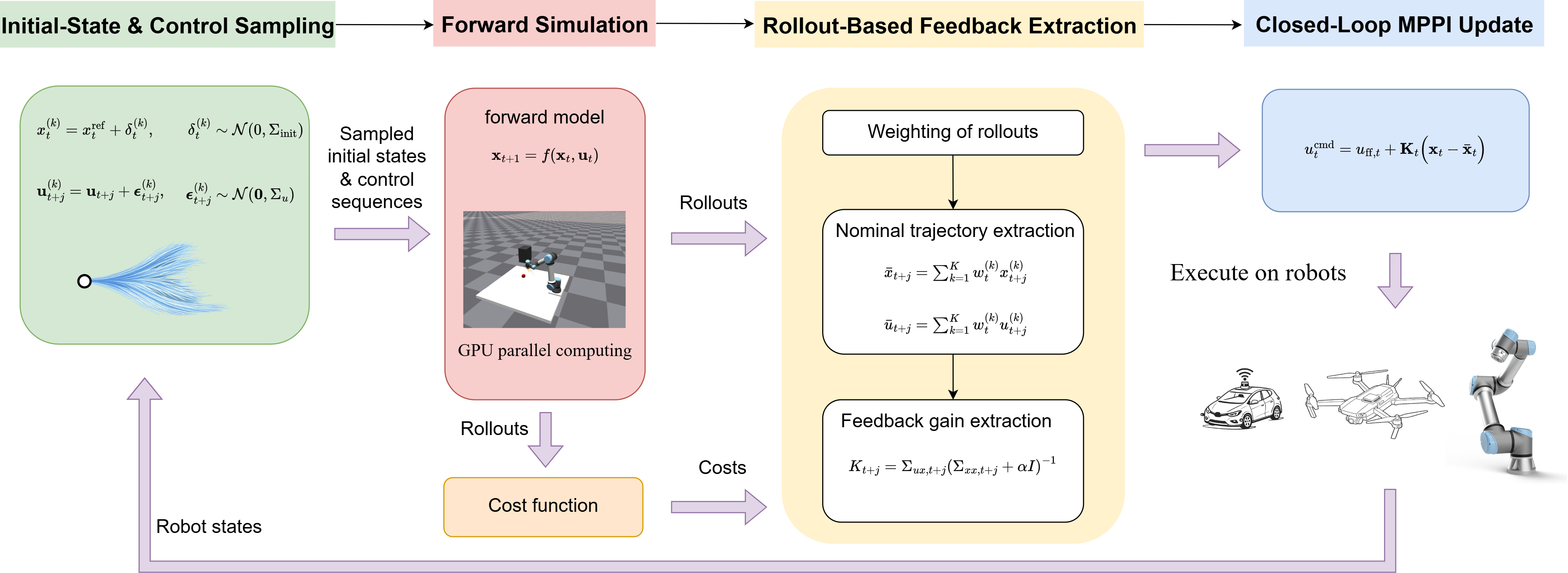
Draw perturbed initial states around the measured state using delay-induced covariance, together with perturbed control sequences.
Run forward simulations in parallel, evaluate trajectory costs, and form an importance-weighted nominal state-control trajectory.
Compute regularized local feedback gains from weighted state-control covariance statistics of the rollouts.
Combine the feedforward command with a correction based on the current measured state at control execution.
utcmd = uff,t + Kt (xt − t)
The feedforward term provides predictive guidance; local feedback corrects execution-time state deviations.
From simulation to hardware
A tabletop obstacle and a vertical wall leave a narrow collision-free passage for the UR5e to reach a target cube.
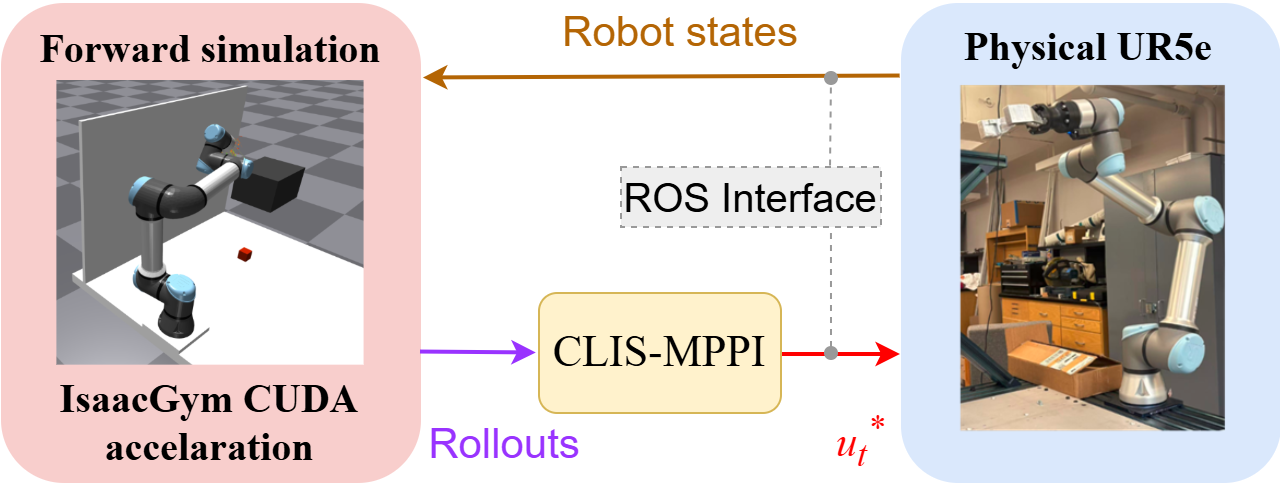
Hardware demonstration
Approaching the obstacle, bypassing it through the gap, and reaching the target.
Experimental findings
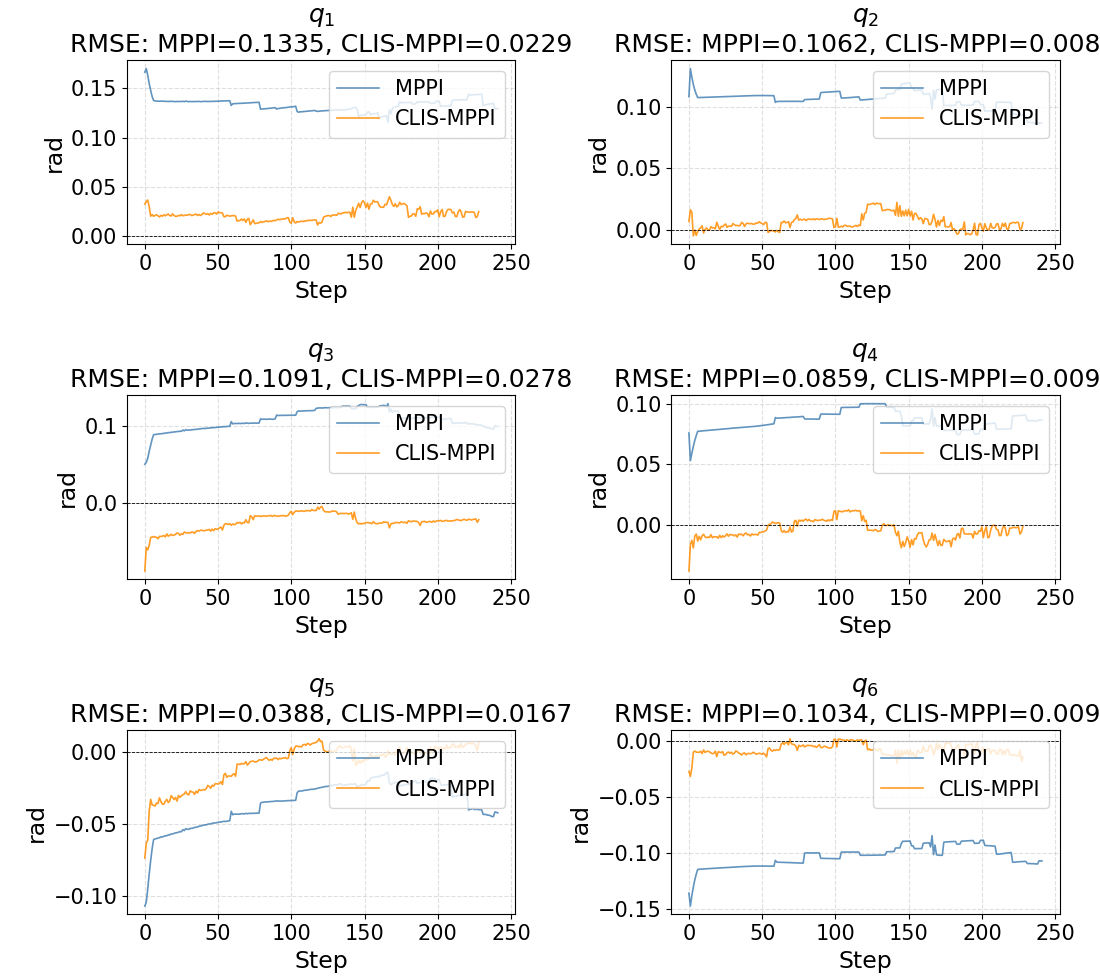
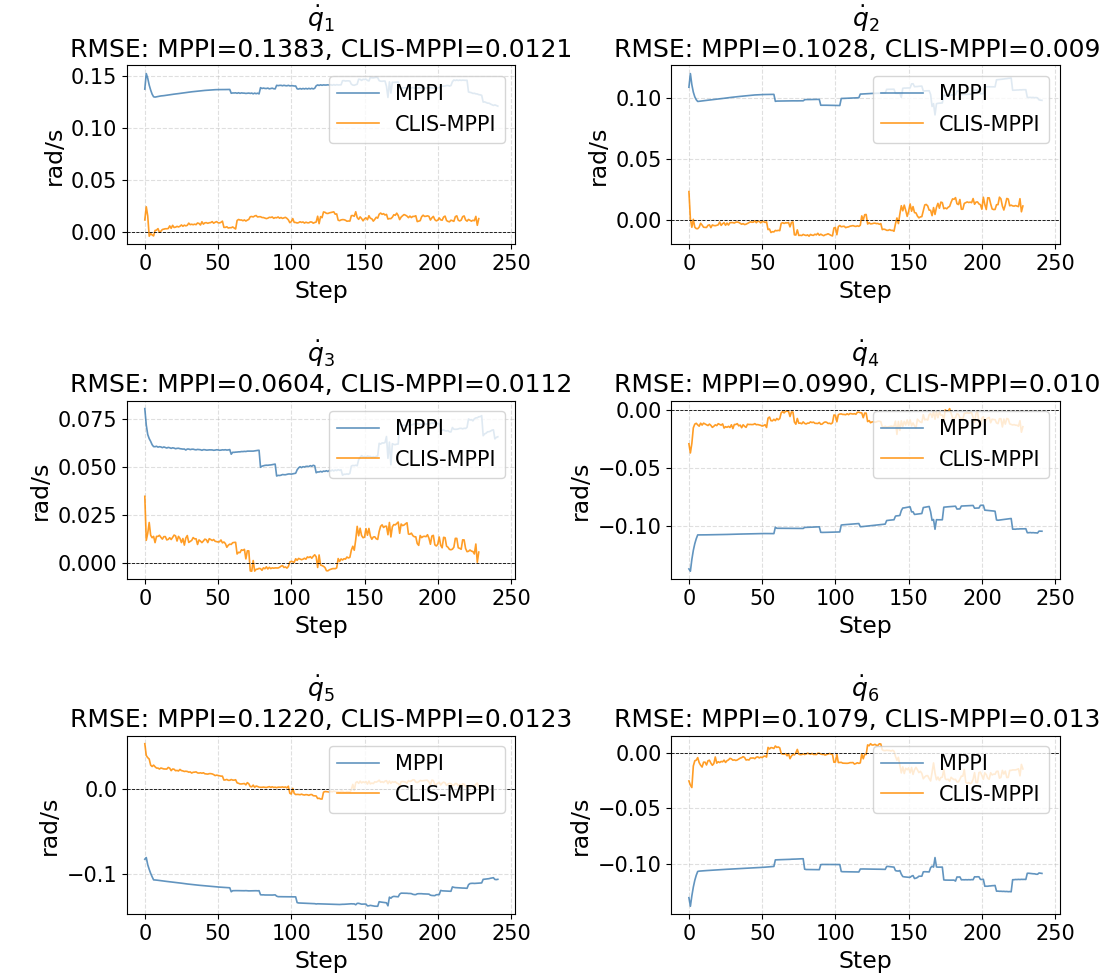
Comparison with standard MPPI on the same real-world narrow-passage task.
| Metric | MPPI | CLIS-MPPI Ours |
|---|---|---|
| Collision-free runs | 3 / 5 | 5 / 5 |
| Mean planning time | 87.5 ms | 87.6 ms |
| Task completion time1 | 25.4 s | 24.4 s |
| End-effector path length1 | 0.456 m | 0.425 m |
| Joint-position RMSE2 | 0.100 rad | 0.017 rad |
| Joint-velocity RMSE2 | 0.108 rad/s | 0.011 rad/s |
1 Completion time and path length are averaged over each method’s collision-free runs: 3 for MPPI and 5 for CLIS-MPPI.
2 RMSE measures deviation from the forward-simulated reference state. The paper reports the error curves from the trial with median end-effector path length among the 3 valid collision-free trials.
Read the full work
CLIS-MPPI: Closed-Loop Model Predictive Path Integral Control With Initial-State Sampling Under Execution Delay
Read paper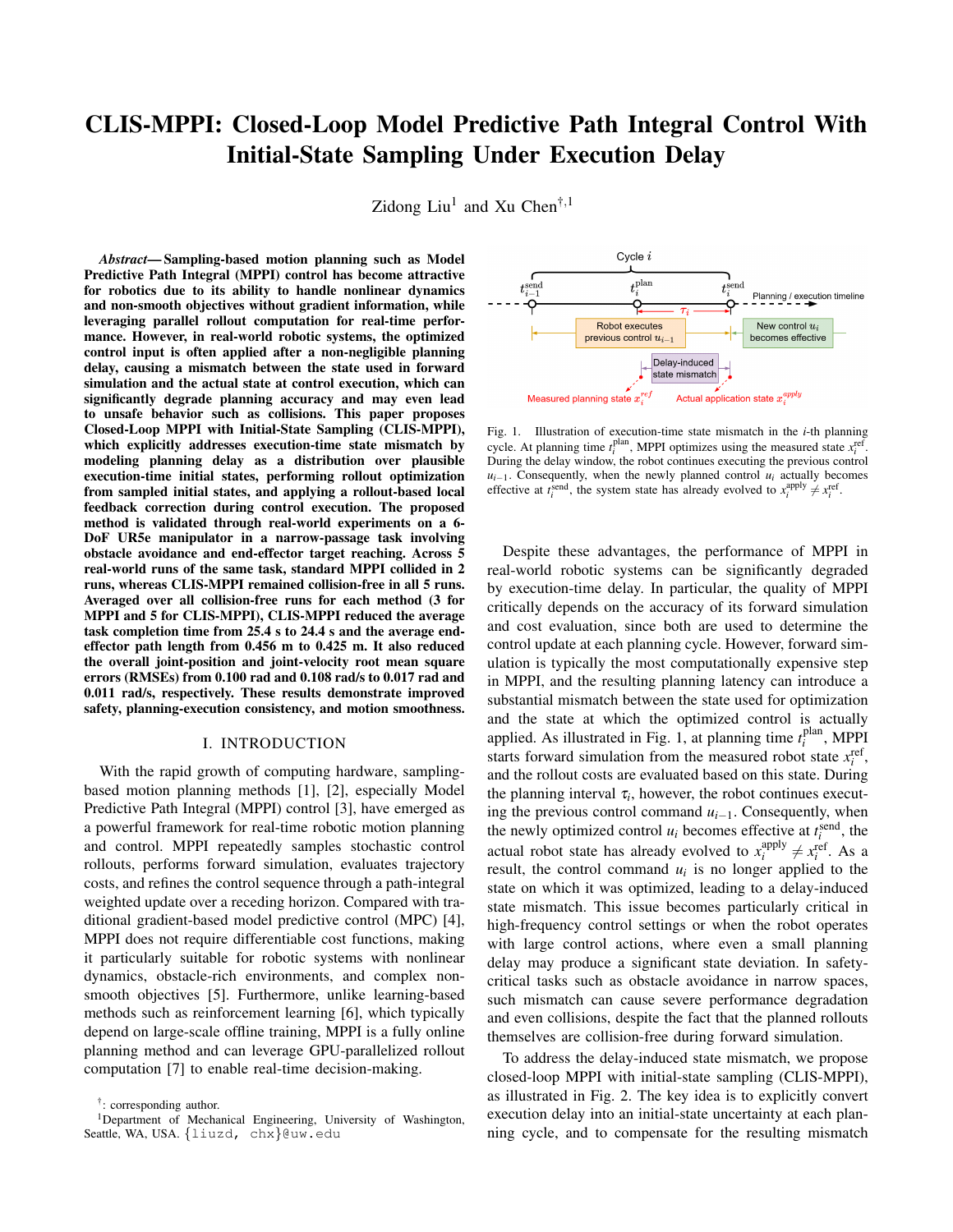
Cite this work
@inproceedings{liu2026clismppi,
  title     = {{CLIS-MPPI}: Closed-Loop Model Predictive Path Integral
               Control With Initial-State Sampling Under Execution Delay},
  author    = {Liu, Zidong and Chen, Xu},
  booktitle = {65th IEEE Conference on Decision and Control (CDC)},
  year      = {2026},
  eprint    = {2610.21239},
  archivePrefix = {arXiv},
  primaryClass = {cs.RO},
  url       = {https://arxiv.org/abs/2610.21239}
}